

9 Fenugreek Benefits for Metabolic and Digestive Health
Last Updated: November 10, 2026
Quick Summary
Fenugreek benefits are best supported for digestion, where its soluble fiber and mucilage can add bulk and help regularity, and for blood sugar, where human studies suggest a modest blunting of the post-meal glucose rise when taken with food. Evidence is limited, effects are modest, and anyone on glucose-lowering medication should consult a clinician first.
- Fenugreek seeds are high in soluble fiber and mucilage, which form a gel in the gut.
- Human blood sugar studies are generally small and short, and effects depend on preparation and dose.
- Fenugreek may modestly blunt post-meal glucose rise when taken with a carbohydrate-containing meal.
- Microbiome claims mostly come from animal studies, so human benefits remain unproven.
- Start with a small daily amount and increase gradually to reduce gas and bloating.
Table of Contents
- What Fenugreek Is and Why It Gets Attention
- Fenugreek Benefits for Blood Sugar: What Human Studies Show
- How Fenugreek Affects Digestion and the Gut Microbiome
- Fenugreek Seeds Soaked in Water Overnight: Benefits and Method
- Fenugreek Tea Benefits and How to Brew It
- Fenugreek Side Effects, Safety, and Who Should Avoid It
- Starting Fenugreek Safely: Choosing a Daily Routine
- Frequently Asked Questions
What Fenugreek Is and Why It Gets Attention
Fenugreek is an annual herb (Trigonella foenum-graecum) whose small, yellowish-brown seeds have been used in traditional cooking and herbal practice for centuries. Its seeds are rich in soluble fiber and a mucilage-type gum that forms a gel when mixed with water.

Fenugreek seeds contain soluble fiber, protein, and compounds called saponins, which give them a bitter taste. These components are the main reason researchers study fenugreek for digestion, appetite, and blood sugar.
Fenugreek Benefits for Blood Sugar: What Human Studies Show
Among the various claimed fenugreek benefits, its effect on blood glucose is the most studied, and it is also the area where readers most often over-read the evidence. The honest summary: human trials exist, but they are generally small, short, and heterogeneous, and the size of any effect depends heavily on the preparation, the dose, and whether the fenugreek was taken with a carbohydrate-containing meal.
What researchers actually measure
When you read a fenugreek study, the headline number is usually one of these outcome measures:
- Fasting blood glucose, a single morning reading, useful but noisy from day to day.
- Post-meal glucose response, how high glucose rises after a standardized meal, often measured over two hours. This is where soluble fiber plausibly has the clearest effect.
- HbA1c, a roughly three-month average of glucose control. Few fenugreek trials run long enough to report a meaningful HbA1c change, which is one reason claims outrun evidence.
A common pattern in the literature is a modest blunting of the post-meal glucose rise when fenugreek is consumed with food, with fasting glucose results that are mixed across trials. "Modest" is doing real work in that sentence: readers should not expect the kind of change a prescribed glucose-lowering medication produces, and no supplement should be positioned as a replacement for one.
Why preparation and dose change the answer
The studies are not interchangeable, and this is the single biggest source of confusion in popular summaries:
- Whole or soaked seeds deliver fiber and mucilage along with the food matrix, so the fiber dose is tied to how much seed a person actually eats.
- Powder and defatted seed powder concentrate fiber and can be stirred into food or water, which makes higher fiber doses easier to reach but also easier to overdo.
- Standardized extracts and capsules may be standardized to saponins rather than fiber, so a capsule dose is not equivalent to a spoonful of seed. Comparing a capsule trial to a soaked-seed trial is comparing different interventions.
Because of this, there is no single "study dose" you can copy from a headline. If you are experimenting, pick one form, keep the amount consistent, and take it with meals rather than on an empty stomach, the fiber mechanism depends on being present alongside carbohydrate.
The mechanism, briefly
Soluble fiber and mucilage form a viscous gel in the gut. That gel can slow the rate at which carbohydrate is broken down and absorbed, which flattens the post-meal glucose curve. Fenugreek also contains saponins and the amino acid 4-hydroxyisoleucine, which have been studied for effects on insulin secretion in laboratory and animal work. That mechanism is plausible and interesting, but it is not the same as a demonstrated benefit in people, and it should not be presented as one.
Animal and lab research versus human evidence
Much of the fenugreek literature comes from animal and laboratory studies, which can show how a compound behaves but do not reliably predict effects in people. Human trials are the better guide for practical decisions, and even they often involve few participants over limited time periods. When you read a headline claiming fenugreek "lowers blood sugar," check three things: whether the study was in animals, in a test tube, or in people; how long it lasted; and whether the comparison was against a placebo or against nothing at all.
What this means if you manage blood glucose
Fenugreek may affect blood sugar, which is why anyone managing glucose should approach it with caution. If you take insulin or a sulfonylurea or another glucose-lowering medication, adding a fiber-rich supplement that also affects glucose can push readings lower than expected.
The table below summarises the main outcome measures and preparation differences that shape how fenugreek study results should be read.
| Measure or form | What it tells you | Key caution |
|---|---|---|
| Fasting blood glucose | Single morning reading | Noisy from day to day |
| Post-meal glucose response | How high glucose rises after a meal | Where fiber has the clearest effect |
| HbA1c | Roughly three-month average | Few fenugreek trials run long enough |
| Whole or soaked seeds | Fiber tied to amount eaten | Dose depends on how much is eaten |
| Powder | Concentrated fiber | Easier to overdo |
| Capsules or extracts | Standardized to saponins | Not equivalent to seed doses |
| Tea | Water-soluble compounds and mucilage | Hardest form to standardize |
How Fenugreek Affects Digestion and the Gut Microbiome
Digestion is where fenugreek's fiber content gives it the most defensible everyday role, and where the microbiome claims need the most careful handling. The two stories are related but not equally supported, so it helps to separate them.
Bowel regularity and stool consistency: the best-supported effect
Because fenugreek seed is high in soluble fiber and mucilage, its most direct digestive effect is mechanical. The mucilage forms a viscous gel in the gut that adds bulk and holds water. This is the effect most consistent with what fiber does generally, and it is the least controversial claim you can make about fenugreek for digestion. It is also dose-dependent: a small culinary amount is unlikely to change much, while a concentrated fiber dose is more likely to move the needle, in both directions.
The microbiome findings: promising, preliminary, and easy to overstate
Fenugreek fiber, like other fermentable fibers, is a food source for gut bacteria, and researchers have studied how it shifts the composition of the gut microbiota. Here is the part popular summaries tend to skip:
- Much of the microbiome research is preclinical. A significant share comes from animal models, including high-fat-diet rodent studies, where fenugreek fiber has been associated with shifts in bacterial populations and with changes in short-chain fatty acid production.
- The measures vary. Studies may report bacterial relative abundance, short-chain fatty acid levels, or gut barrier markers, different outcomes that are not directly comparable to one another.
- Animal high-fat-diet models do not translate cleanly. A rodent on a high-fat diet has a different baseline microbiome, a different gut transit time, and a different fiber intake than a person eating a mixed diet. A shift that looks meaningful in that model may be small, absent, or differently shaped in humans.
The fair summary: fenugreek fiber plausibly feeds gut bacteria and may influence the gut environment, but the specific human microbiome benefits remain unproven. Treat microbiome claims as mechanism, not outcome.
Digestive side effects and how to reduce them
Gas, bloating, and loose stools are the most frequently reported digestive effects, and they are more common at higher doses and when fiber intake jumps quickly. A common pattern that works better than a large starting dose:
- Start with a small amount, a teaspoon of soaked seeds or a partial serving of powder, once daily with a meal.
- Increase gradually over one to two weeks rather than jumping to a full dose.
- Drink plenty of water throughout the day; fiber without adequate fluid can worsen constipation rather than relieve it.
- Keep other fiber supplements steady while you adjust, so you can tell what is causing what.
Watch out: if bloating is severe, painful, or accompanied by a change in bowel habits that persists beyond a couple of weeks, stop and talk to a clinician rather than pushing through, persistent digestive symptoms deserve evaluation, not more supplement.
Who should be cautious on the digestive side
Anyone with a history of bowel obstruction, narrowing, or a condition that requires a restricted-fiber diet should not add a concentrated fiber supplement without medical guidance. If you are comparing digestive supplement formats and how well adults absorb them, our guide to which absorption formats work better for adults over 40 explains the differences, and for everyday habits that support the gut alongside any supplement, see how to improve gut health naturally.
Fenugreek Seeds Soaked in Water Overnight: Benefits and Method
Soaking fenugreek seeds overnight is one of the most common traditional preparations. The seeds swell and release mucilage, which makes them softer and less bitter.
To prepare them, rinse about one tablespoon of seeds, cover them with water in a jar, and leave them at room temperature overnight. In the morning, drain the seeds and eat them or blend them into a smoothie.
Fenugreek Tea Benefits and How to Brew It
Fenugreek tea is a gentler way to take the herb, particularly for people who dislike the taste of the seeds.
Herbal teas are generally easier to drink daily than concentrated capsules, but their potency is hard to standardize. If you prefer a ready-made blend, Iron Faith Nutrition's EsseHerbal Tea 8 Herbs is formulated as a traditional herbal tea for digestive and general wellness.

Fenugreek Side Effects, Safety, and Who Should Avoid It
Digestive upset is the most common. Some people also report allergic reactions, including skin rash, and fenugreek has been linked to a maple-syrup odor in urine and sweat in some users.
People taking diabetes medications should speak with a clinician before using fenugreek, because combining the two may affect blood sugar. It may also interact with blood thinners and other medications. Pregnant or breastfeeding women should check with a healthcare provider before using fenugreek.
Anyone with a diagnosed condition, persistent digestive symptoms, or unexplained changes in blood sugar should seek medical advice rather than self-treating. If symptoms are severe or do not resolve, stop use and contact a healthcare professional.
Starting Fenugreek Safely: Choosing a Daily Routine
If you decide to try fenugreek, start with a low dose and take it consistently with meals for at least several weeks before judging the effect.
Choose a single form to start, whether seeds, tea, or capsules, so you can tell what is working.
*These statements have not been evaluated by the Food and Drug Administration.
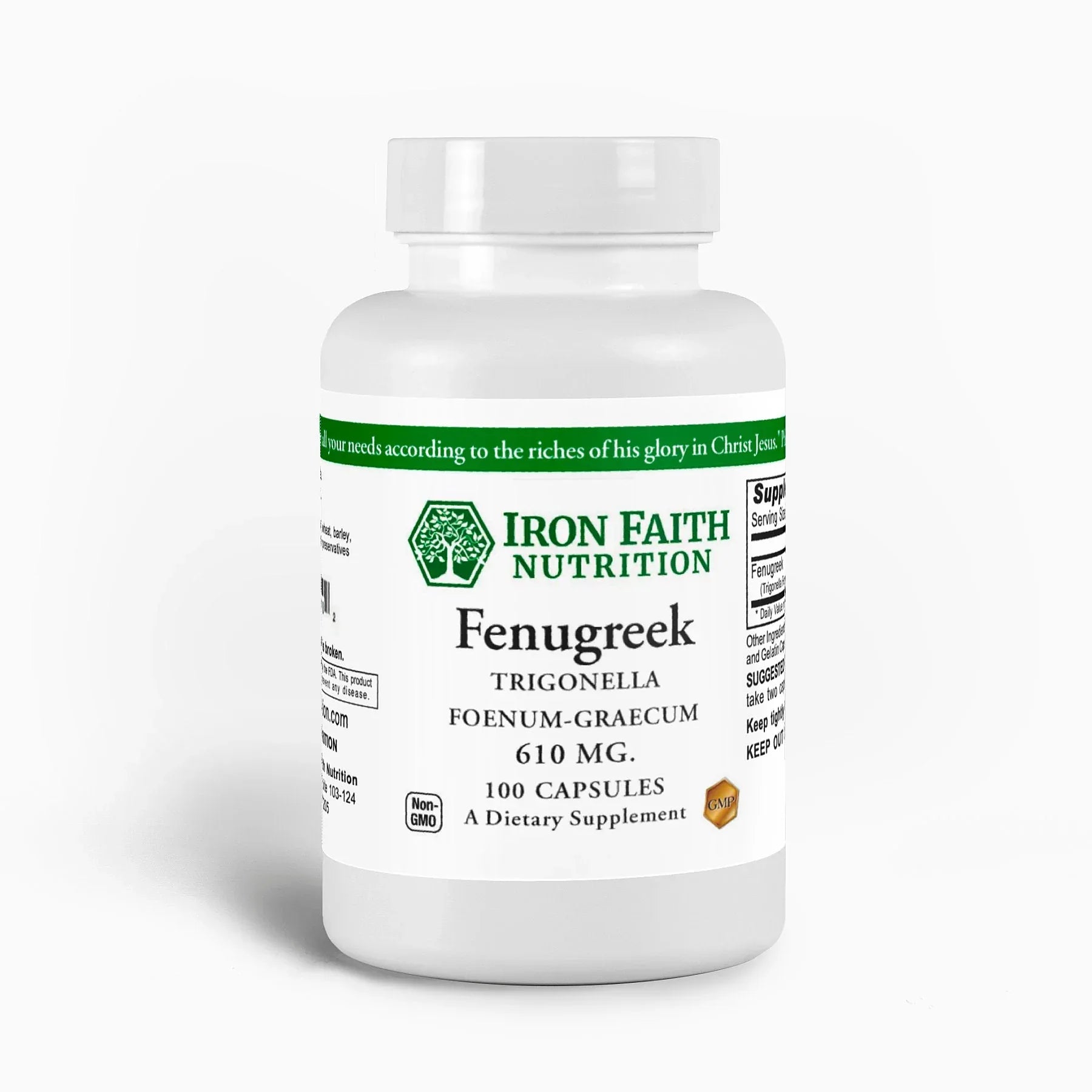
Explore Iron Faith Nutrition's Fenugreek, Metabolic, Glucose & Digestive Support formula to see how it is designed for daily use.
Frequently Asked Questions
What happens if I take fenugreek every day?
Daily use is what most people mean by a routine, and the studies that looked at blood sugar and appetite generally tested fenugreek over several weeks, not a single dose. Common reported effects are mild digestive changes such as gas, bloating, or loose stools, especially when people start with a high dose. Taking it with meals and starting low lets you judge how your body responds. If you have a blood sugar condition or take glucose-lowering medication, talk with a health care professional before daily use, since fenugreek may add to the effect of those drugs.
Can fenugreek help with blood sugar?
Research results on fenugreek and blood sugar are mixed, and effects vary by preparation and dose. Fenugreek should be treated as a supporting part of a wellness routine, not a replacement for prescribed diabetes care. Anyone managing blood sugar should monitor their levels and consult a health care professional before making changes.
What are the side effects of fenugreek?
The most frequently reported side effects are digestive, including gas, bloating, diarrhea, and an upset stomach. Because it can affect blood sugar and may interact with blood thinners and other medications, people who are pregnant or nursing, have diabetes, or take prescription drugs should check with a professional first. Stop use and seek medical advice if you notice an allergic reaction, such as rash, swelling, or breathing difficulty.
Should I take fenugreek in the morning or at night?
Many people take fenugreek with meals, which fits the digestive and blood sugar goals most research has examined. Taking it with breakfast or lunch can make it easier to remember a daily routine. Because the fiber can affect how the stomach feels, some people prefer not to take a large dose right before bed. Timing matters less than consistency and staying within the directions on the label. Check with a professional if you take other medications that need to be spaced out.